
Sex Offender Checks in Linn County
The Iowa Sex Offender Registry is the primary source for a Linn County sex offender search. The Iowa Department of Public Safety, Division of Criminal Investigation maintains it. The registry began in July 1995 and is usually updated hourly on weekdays during business hours. Searches are free and do not require an account. An account is needed to create watches that send notice after a change to watched registration data.
Start with the tool that matches the question. A name search is best when the registrant is known. County, city, ZIP, address, or map controls help with community awareness. Telephone and email searches test whether those identifiers are associated with a public registry profile. The separate Most Wanted search concerns noncompliant or absconded registrants. It should not be confused with the full Linn County registry list.
Five Linn County Registry Routes
The official Iowa registry provides Basic, Advanced, Map, Telephone, and Email searches. Basic search keeps the input narrow. Advanced search adds registry number, gender, location, update-date, and most-wanted controls. The Map tool focuses on geography. Telephone and Email tools are identifier checks, not substitutes for a name or location review.
- Basic: Search by first name, last name, aliases, or ZIP code.
- Advanced: Add OCI number, gender, county, city, address, update date, or most-wanted status.
- Map: Review public registration locations in a geographic view.
- Telephone: Check whether a phone identifier is tied to a public registrant entry.
- Email: Check whether an email identifier is tied to a public registrant entry.
Use more than one route when the first result is uncertain. A partial name can yield multiple people, while a geographic search can include nearby entries outside the precise place a reader had in mind.
How to Search the Iowa Registry
The basic Linn County search accepts optional fields, so a broad query may be useful before adding location limits. Match the result by name, aliases, photograph, physical description, address information, offense jurisdiction, and registry identifier. A shared name is not enough. Review the profile's update time and status before relying on it.
- Open the official Iowa Sex Offender Registry and choose Basic, Advanced, Map, Telephone, or Email search.
- Enter a name or identifier, or choose Linn County, city, ZIP, address, or map controls for a geographic inquiry.
- Review the result list and compare several identity fields rather than selecting a person by name alone.
- Open the full profile, read its registration and conviction details, and note the update timestamp and compliance status.
| Basic field | Type | Required | Format or use |
|---|---|---|---|
| Last Name | Text | No | Supports prefix-style matching. |
| First Name | Text | No | Supports prefix-style matching. |
| Also Search Aliases | Checkbox | No | Includes alternate names. |
| Zip Code | Text | No | Applies a geographic filter. |
| Search | Button | Not applicable | Runs the query. |
The image below is from the official Iowa registry search.
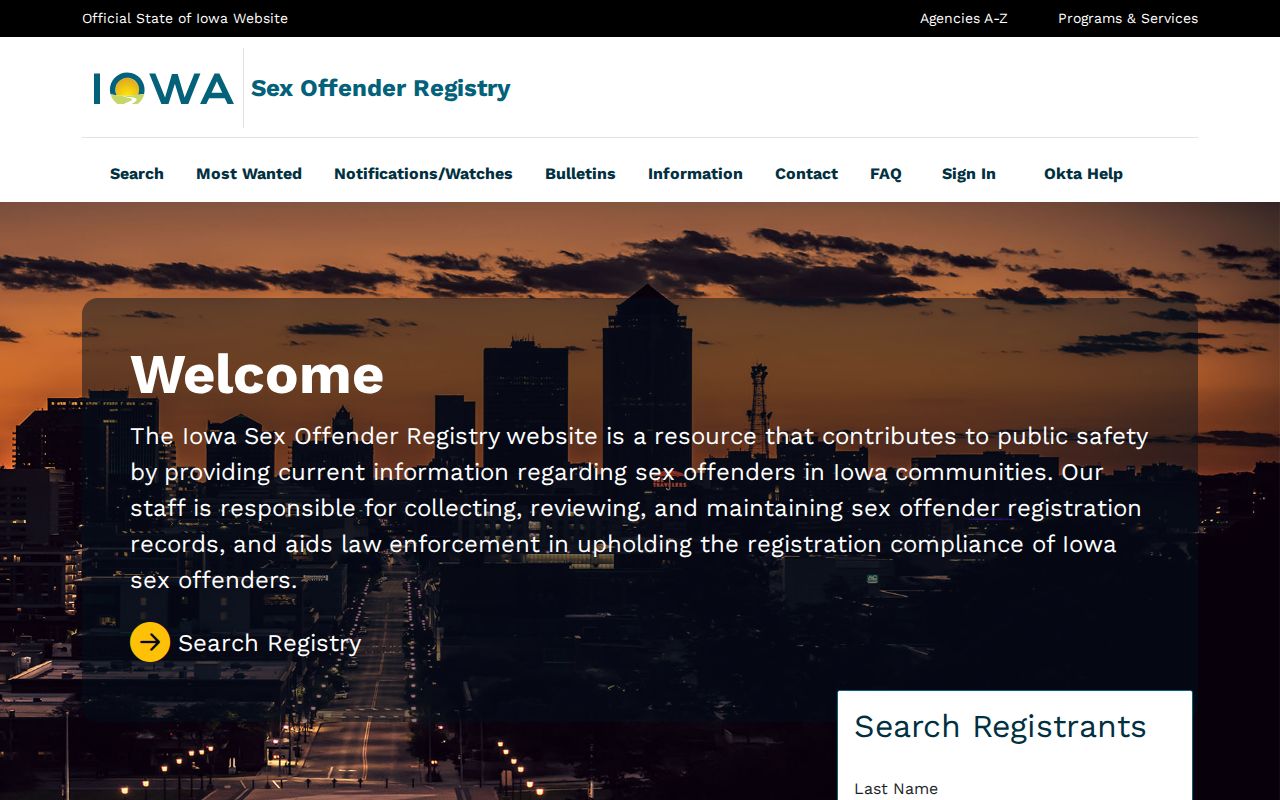
Its basic controls offer a direct first pass before the advanced and geographic search tools add more filters.
Linn County Map and ZIP Searches
A ZIP search groups results through a postal area. The map displays location data in geographic form. Neither tool, by itself, proves that a home violates an exclusion rule. Boundaries, address effective dates, offense classification, legal exceptions, and the current text of Iowa Code chapter 692A all matter. A point that looks close to a school, park, or another site is not a legal finding.
Use the map to support awareness and the profile to verify the registrant and update time. For a concern about local compliance, contact the Linn County Sheriff rather than confronting anyone. Residence-restriction and exclusion-zone questions require a current review of chapter 692A. The registry's visual distance should never be used as a stand-alone claim of unlawful residence.
Inside a Registry Profile
A public Linn County profile combines matching information with statutory registration data. Identity fields can include a name, middle name, suffix, aliases, photograph, sex, and physical descriptors. Address entries may show current and prior locations with effective dates. Conviction and registration sections describe qualifying offenses, jurisdictions, dates, status, and related duties. Vehicles, approved telephone or email fields, and scars, marks, or tattoos can aid a careful match.
| Identity | Name, middle name, suffix, aliases, registry or OCI identifier, sex, and physical descriptors. |
|---|---|
| Photograph and markings | Public image plus scars, marks, and tattoos when released. |
| Address information | Current and previous locations, city, county, ZIP code, and effective dates where public. |
| Offense information | Conviction descriptions, jurisdictions, dates, and registration information. |
| Status | Compliance or most-wanted status and an update timestamp. |
| Other identifiers | Vehicles and publicly authorized telephone or email information. |
| Protected information | Victim identity is not shown and must never be reconstructed from the offense description. |
A Linn County registry profile is not a complete criminal case file. For filed motions, pleas, judgment, and sentence, use the Linn County criminal court case search.
Linn County Registry Watch Notices
Linn County registry searches are snapshots. A watch can track later changes to selected registration information. The Iowa system states that email notices are sent within 60 minutes of a change to watched data. Account holders manage those alerts through My Account and My Watches. A watch does not replace a new profile check when a current answer matters.
The registry normally refreshes hourly on weekdays during business hours. That schedule helps explain why a recently reported change may not appear at once. Check the profile timestamp, then contact the Linn County Sheriff or Iowa DCI Registry when accuracy or compliance is in doubt. Do not treat a brief lag as proof of noncompliance.
Note: Watch notices report registry changes; they do not announce every police, court, or supervision event involving a registrant.
Iowa Registration Levels and Requirements
Iowa uses offense-based registration under Iowa Code chapter 692A. It is not a simple public risk score. Qualifying offenses can include offenses against a minor, sexual exploitation, and sexually violent offenses, along with qualifying out-of-state, federal, and deferred dispositions. The exact duty depends on the offense, classification, date, history, and current statute.
The research did not establish a reliable 2026 table of exact tier durations and in-person verification intervals. Generic federal periods should not be substituted for Iowa law. The table therefore preserves only the verified category-level guidance and directs readers to sections 692A.103 through 692A.108 for the exact case.
| Iowa category | Duration and verification | Public-use note |
|---|---|---|
| Tier I | Depends on the exact offense and current chapter 692A requirements. | Confirm the profile and statute; do not infer a risk score from the tier. |
| Tier II | Longer offense-based registration may apply; verify the exact period and in-person schedule. | Public fields reflect registration law, not the full court file. |
| Tier III | The most serious tier commonly uses a lifetime framework, subject to the current statute. | Confirm statutory exceptions and the registrant's current profile. |
Linn County Registration Contacts
The Linn County Sheriff's Office is the local contact for registration and compliance questions. Call 319-892-6100. The Iowa DCI Registry can be reached at 515-725-6050, fax 515-725-6040, or at 215 E. Seventh Street, Des Moines. These offices can address information that a public profile or map cannot resolve.
Linn County Sheriff
Local registration and compliance questions
319-892-6100
Iowa DCI Registry
215 E. Seventh Street
Des Moines, Iowa
515-725-6050
Fax: 515-725-6040
Report suspected noncompliance through law enforcement. Do not visit a listed address, try to confirm a person's identity in public, or attempt detention. The registry's Most Wanted feature is an absconder and noncompliance search, not an invitation for public action.
The image below comes from the registry's official Most Wanted search and safety notice.
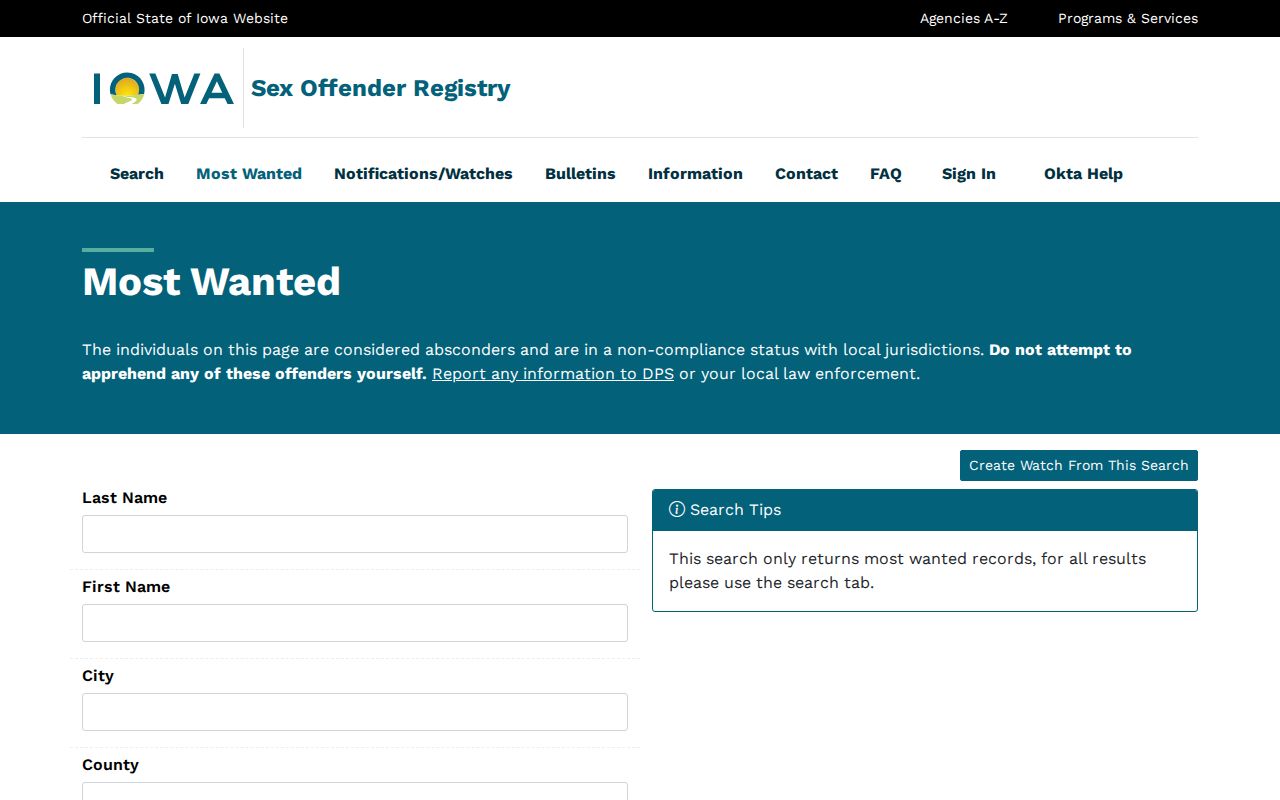
Its warning reinforces the safe response: send useful information to DPS or local law enforcement and never attempt apprehension.
Linn County Registry and NSOPW
The Linn County registry view is the best source for Iowa-specific fields, search tools, watches, and local contact routes. The U.S. Department of Justice National Sex Offender Public Website adds a cross-state search layer. It is useful when an address history or concern may cross Iowa's border, but it does not replace the state profile or the Linn County Sheriff's compliance role.
Compare results across systems with care. Search scope, update timing, and released fields can differ by jurisdiction. A person missing from a national query is not proof that no Iowa duty exists, just as a shared name is not proof of identity. Return to the Iowa profile, review several identifiers, and ask the official registry when the systems appear inconsistent.
Community Notification and Lawful Use
The Linn County sex offender search exists for public awareness and safety planning. It does not authorize threats, intimidation, harassment, discrimination, or vigilantism. Victim identity is excluded from public profiles. Do not try to derive it from an offense description or court narrative. Use account watches for notice of changed registration information and use law enforcement contacts for suspected noncompliance.
A registry listing also does not answer every question about a conviction. The court file records the judgment and sentence. The registry reflects current duties under chapter 692A. Keep those functions separate when interpreting the result.
Registry misuse can be a crime: Iowa Code chapter 692A governs the registry, and using its information to threaten, intimidate, or harass a registrant or household is unlawful. Never approach a person listed as noncompliant; report the information to law enforcement.