
Linn County Criminal Court Cases
The Iowa District Court for Linn County is the county's state trial court. It sits in the Sixth Judicial District and hears felonies, indictable misdemeanors, simple misdemeanors, traffic matters, and city-originating cases. Iowa has a unified district court. Cedar Rapids, Marion, and Hiawatha do not maintain separate municipal criminal dockets. The Linn County Attorney files and prosecutes state criminal charges, while the Clerk of Court keeps the case file.
That split matters. A police department owns its incident narrative, the jail owns its intake and custody data, and the Clerk owns the filed complaint or trial information, docket, orders, plea, judgment, sentence, and financial ledger. The Linn County courthouse has twelve adult civil and criminal courtrooms. Its address is 51 Third Avenue Bridge, Cedar Rapids, IA 52401. The Clerk's main number is 319-398-3411, with Criminal and Traffic extensions 1132 or 1162.
Linn County Clerk Owns Case Files
A missing document online does not move custody of the Linn County court record to the Sheriff. The Clerk keeps pending and recent paper files, older microfiche or digital material, and the court's docket database. Start with the case number when possible. Without it, give the spelling used when the case was filed and an approximate year. Ask whether the item appears in the free public view, requires subscriber access, or must be inspected or copied at the courthouse.
Published Iowa court guidance lists a copying rate of $0.50 per page, with possible charges for supervision or special services. Confirm the current cost with the Linn County Clerk before ordering a large file. A focused request should identify the exact order, charging paper, judgment, sentencing entry, or docket span needed. That is faster than asking for every document associated with a name.
Iowa District Court Clerk
51 Third Avenue Bridge
Cedar Rapids, IA 52401
319-398-3411
Criminal and Traffic: ext. 1132 or 1162
Searching Linn County Case Records
Iowa Courts Online is the statewide starting point for Linn County criminal court cases. A case number is the cleanest key. A name search can return people with similar names, so confirm the county, case type, filing date, and party role before treating a result as a match. Free access shows basic public docket information. The official court help materials say subscription access adds more party, docket, financial, exhibit, judgment, lien, and traffic details.
- Open Iowa Courts Online and choose the trial court case search.
- Enter the case number, or use the person's filed last and first names.
- Select Linn County and a criminal or traffic case type when a narrow local result is needed.
- Open the matching case and read the charge, status, docket events, scheduled dates, disposition, and financial entries in context.
- Call the Linn County Clerk for a copy, certification, archived item, or document that the online view does not expose.
| Field or control | Type | Required | Use |
|---|---|---|---|
| Search type | Tabs or menu | Yes | Choose trial court rather than appellate or payment paths. |
| Case Number | Text | Alternative | Most precise route when known. |
| Last Name / Company Name | Text | Alternative | Starts a party-name search. |
| First Name | Text | Conditional | Narrows a person search. |
| County | Dropdown | No | Select Linn for local court cases. |
| Case Type | Dropdown | No | Narrows criminal, traffic, and other case groups. |
| Search / Reset | Buttons | Not applicable | Runs the query or clears the fields. |
If the first query returns no Linn County case, clear the narrow filters and try the filed name again. A county filter can hide a matter filed elsewhere, and the public view may not expose every document that the Clerk can locate.
Linn County Docket Access Levels
Free and subscribed court views are not the same product. The basic Iowa Courts Online result is useful for identifying a Linn County case and tracing core public events. The official field guide describes a wider subscription view with expanded party and trial-court details, exhibits, judgments and liens, financial data, and traffic fields. Neither view guarantees that every underlying document can be opened remotely.
The official Iowa Courts Online field guide helps explain those layers. Use the public docket as an index, not as proof that unseen material does not exist. Some documents require an account, courthouse access, or a direct request. Others are confidential by law. Overly narrow county or case-type filters can also hide a relevant case filed elsewhere.
The image below comes from the official statewide case-search interface.
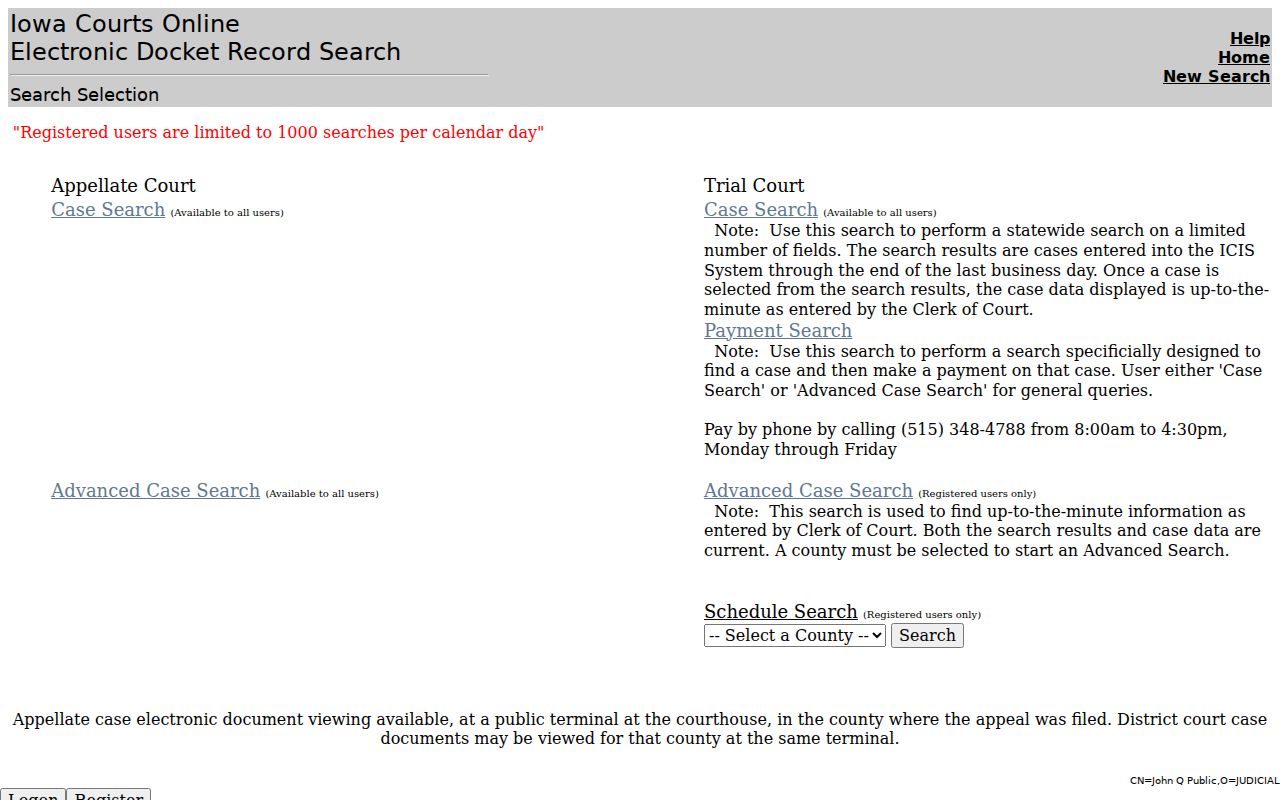
Its controls provide the first route into a Linn County docket, while the Clerk remains the source for the complete public file.
Inside a Linn County Case File
A Linn County court case should be read in layers. The header identifies the court, county, case number, filing date, case type, caption, and status. Party data separates the defendant, State of Iowa, attorneys, and other roles. Charge rows may show a code, description, classification, amendment, and outcome. The docket then records events in time order. A financial layer can show fines, surcharges, costs, restitution, payments, and a balance.
| Case identity | Case number, Linn County, title, type, filing date, and current status. |
|---|---|
| Parties and counsel | Defendant, State of Iowa, attorneys, and other filed roles. |
| Charges | Code, description, offense class, amended counts, and charge-level disposition. |
| Docket events | Initial appearance, arraignment, plea, motions, orders, trial information, hearings, and public warrant activity. |
| Outcome | Disposition, judgment, sentence, and later satisfaction or compliance entries. |
| Financial record | Fine, surcharge, court cost, restitution, payment, and balance fields. |
| Documents | Links where available; a docket line may remain public even when its document is restricted. |
Do not read a scheduled event as a final result. An old charge label may not be the offense of conviction, and a dismissed count can remain visible as part of the Linn County case history.
Read Linn County Dockets in Order
The charge first entered at booking can change before the County Attorney files trial information. It can change again through amendment or plea. For that reason, compare the filed charge row with the latest disposition and judgment rather than relying on the first label. A docket is chronological, and each line marks an event, filing, or order. It is not a one-line verdict.
- Trial information
- The Iowa prosecutor's formal charging document for an indictable offense.
- Arraignment
- The stage at which the filed charges are stated and a plea is entered.
- Disposition
- The procedural result for a charge or case, such as conviction, dismissal, or acquittal.
- Judgment
- The court's formal decision following a plea, verdict, or other resolution.
- Restitution
- Court-ordered payment for a qualifying loss, shown separately from some other financial obligations.
When a result seems inconsistent, compare the charge-level disposition, case-level status, judgment, and sentence. The broader Linn County criminal history overview explains why a court file may also differ from a DCI rap sheet.
How a Criminal Case Moves
A filed Linn County criminal case moves through judicial events rather than a fixed clock. An initial appearance addresses custody, rights, and release. The prosecutor's charging document defines the counts the court will handle. Arraignment records the plea. Pretrial filings can include motions, discovery disputes, scheduling orders, and amendments. A plea or trial produces the disposition, followed by judgment and sentencing when guilt is established.
Case flow: Charges Filed › Arraignment › Pretrial › Plea or Trial › Disposition › Sentencing
Linn County publishes a useful intake detail: weekday arrestees booked before 6:30 a.m. are set for a 10 a.m. arraignment, while weekend or holiday bookings before 5:30 a.m. are set for 9:30 a.m. The Clerk, not the jail roster, supplies future court dates. Bond goes through the Clerk during business hours. When the Clerk is closed, the jail lobby accepts cash-only bond, and all arraignment bonds are posted at the jail.
The image below is drawn from Linn County's official arraignment and bond instructions.
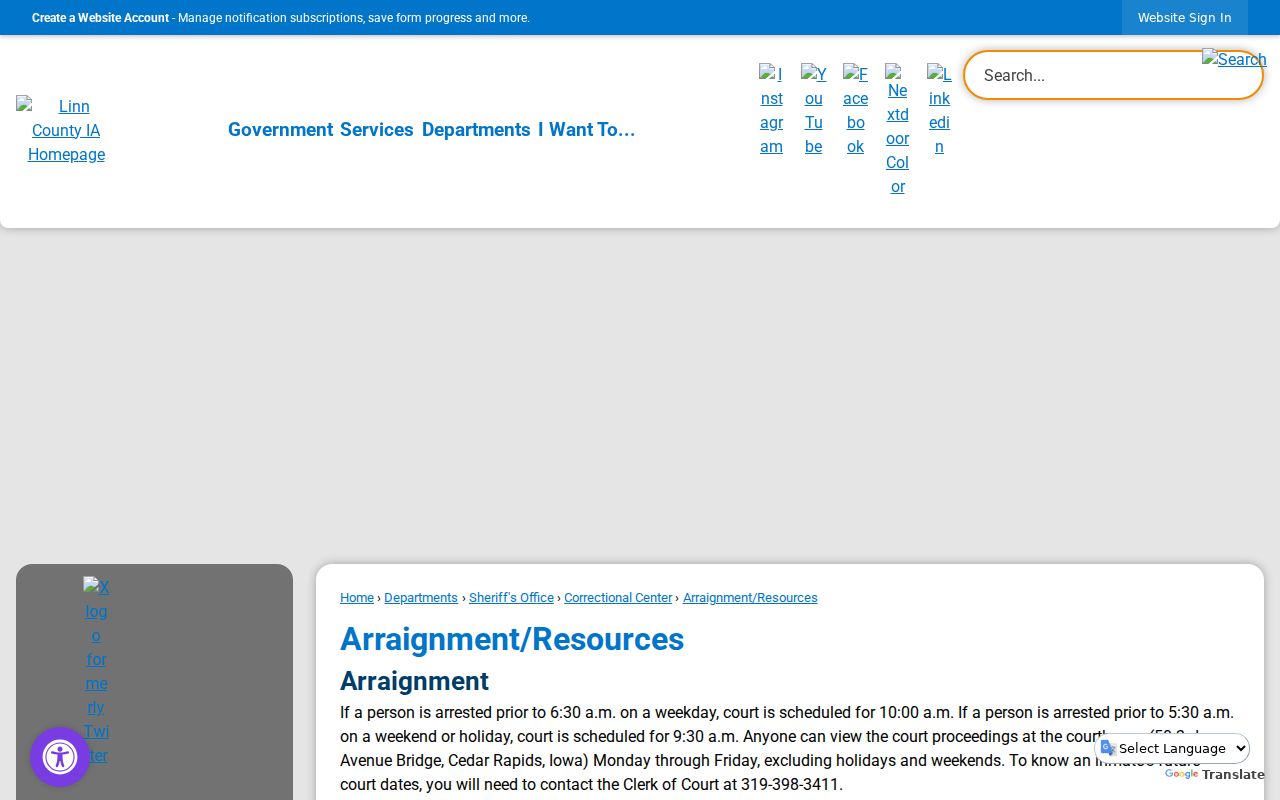
Those local cutoffs explain the first court stop, but later dates and the final outcome must be read from the Linn County docket.
Linn County Has One Trial System
A Cedar Rapids, Marion, or Hiawatha police case does not create a separate city criminal court file. Iowa's unified system routes city ordinance, simple misdemeanor, indictable misdemeanor, felony, and traffic matters into the Iowa District Court. Search Iowa Courts Online with Linn County selected, then contact the Linn Clerk when a city-originating case needs a filed document.
This rule prevents a common dead end. The city police department may hold the report that describes what officers saw. Once a charge is filed, the Iowa District Court for Linn County holds the court record. Federal cases are different and belong to the U.S. District Court for the Northern District of Iowa in Cedar Rapids, with federal docket access through PACER.
Case Record Access & Restrictions
Iowa Code chapter 22 supports examination and copying of public records, while court rules and confidentiality laws protect specific material. Most adult Linn County criminal dockets are public. Unexecuted search and arrest warrants, presentence investigations, deferred-judgment dockets, specified juvenile matters, protected victim information, medical details, and sealed files can be withheld or redacted. Public access to a docket line does not always include access to the document behind it.
Iowa Code sections 22.2 and 22.7 set the broad right of access and the confidential-record limits. Iowa Court Rules chapter 16 governs electronic filing and protected information. If a Linn County case is absent online, first verify spelling, case number, year, county, and type. Then ask the Clerk about paper, microfiche, digital archives, or a confidentiality restriction.
Access is not the same as completeness. A free search may omit documents or subscription fields, while sealed and confidential material remains unavailable to the public.
When Linn County Dates Are Missing
The current jail roster answers a custody question. It is not the calendar for a Linn County criminal case. If no future date appears there, use the case number in Iowa Courts Online or call the Clerk. A person may have been released, transferred, cited without a jail stay, or booked before the court created the next scheduled event.
A missing search result also is not proof that no Linn County record exists. Try the filed form of the name, remove a narrow date filter, and check whether the case was filed in another county. For an older matter, ask the Clerk which archive holds the docket and whether a public copy can be made. These checks preserve the distinction between an access gap and a nonexistent case.
Note: An arrest allegation is not a conviction; the filed disposition and judgment show how the court resolved each count.